I. The Sound of Grit
The city wakes before the sun. Delivery trucks hiss through alleys, steam rises from manhole covers, and the clang of construction echoes like heartbeat percussion. Philadelphia’s rhythm is work — no frills, no apologies, no shortcuts.
Somewhere between those sounds lives Jason Kelce.
He’s long been the pulse of this city’s most beloved franchise — the bearded brawler who looked more like a South Philly dockworker than a multimillion-dollar athlete. But in truth, that’s exactly why the city loved him. He was them, in pads and cleats.
Now, months removed from his final snap, as Kelce transitions from the trenches of Lincoln Financial Field to the spotlight of television studios and podcast microphones, one truth remains: he never stopped being Philly.
Because to embody this city isn’t to win prettily. It’s to survive beautifully.
II. Born for the Blue-Collar Stage
Jason Kelce wasn’t supposed to last 13 seasons in the NFL. Drafted in the sixth round in 2011 — 191st overall — he was undersized, under-hyped, and barely 295 pounds on a good day. Scouts saw him as too small to anchor an NFL line, too reckless to control his aggression.
What they missed was the marrow of a fighter.
“I’ve been doubted since high school,” Kelce once said. “And Philly — Philly feels like home because it’s full of people who’ve heard ‘you can’t’ and said, ‘watch me.’”
From the moment he first pulled on midnight green, he became the city’s mirror. Kelce’s brand of football wasn’t elegant; it was industrial. The dirt under his fingernails was as much a badge of honor as the Super Bowl ring he’d eventually earn.
He wasn’t just a player who worked hard. He was a man who understood why you work hard.
III. The Sound of the Parade
The morning after the Eagles’ first Super Bowl championship, Philadelphia was louder than it had ever been. Parade confetti fell like metallic snow across Broad Street. And in the middle of it all, dressed in a Mummers costume — feathers, sequins, and fire in his eyes — Jason Kelce took the mic.
What came next became folklore.
He didn’t give a speech. He gave a sermon.
“Hungry dogs run faster!” he roared, his voice breaking through decades of frustration, mockery, and national dismissal. “And that’s why we’re the champions!”
That day, he became more than a football player. He became the beating heart of Philadelphia’s identity — the living embodiment of what the city always believed about itself: that it wins not because it’s the biggest or richest, but because it refuses to quit.
IV. Behind the Mask of Iron
What people often forget about Kelce is that toughness isn’t his armor — it’s his empathy.
Teammates recall how, after grueling practices, he’d sit beside rookies in the cafeteria, talking through their struggles, their fears, their bills. “He made you feel seen,” said former guard Brandon Brooks. “He didn’t big-time anyone. He was one of us — even when he was a legend.”
In the locker room, his leadership wasn’t loudness; it was presence. When injuries piled up, when games slipped away, Kelce’s words steadied chaos. “We’re built for storms,” he’d say. “This city don’t drown easy.”
That resilience came not from invincibility, but from scars. Kelce’s knees were rebuilt twice. His elbows carried metal. His hands looked like tools. Yet he never flinched — not from pain, not from scrutiny, not from the loneliness of accountability.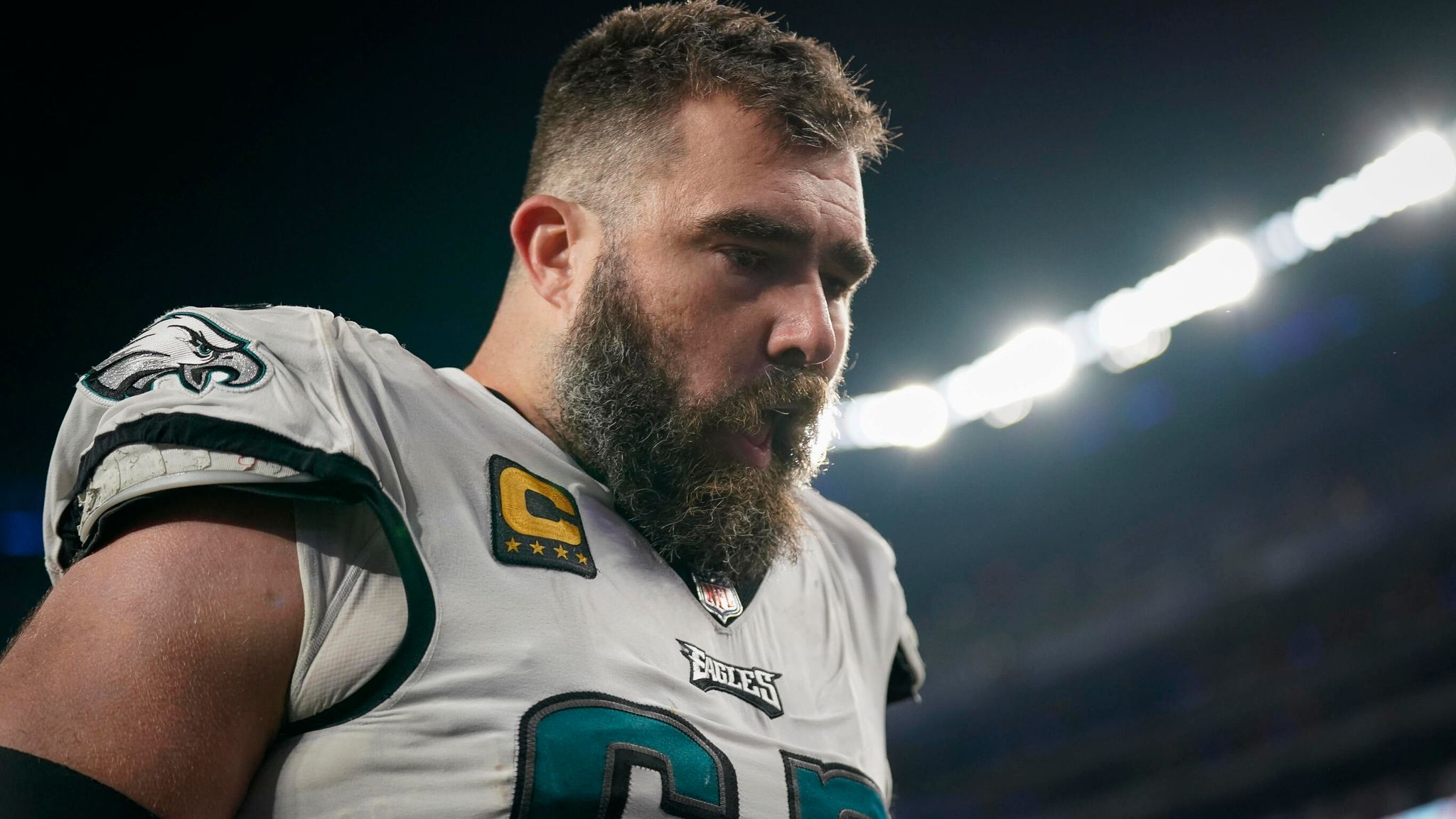
V. The Philosophy of Pain
Every football player knows pain. Few study it.
Kelce approached it like a philosopher — measuring what it taught him. “Pain’s information,” he once said in a documentary. “It tells you where you’re weak, but also where you’re alive.”
He played through sprains, tears, bone bruises, and heartbreaks. But he also laughed through them. To him, the suffering wasn’t something to hide; it was something to share.
When a younger teammate once apologized for limping through drills, Kelce stopped him. “Never apologize for trying,” he said. “That’s the job — trying when it hurts.”
That simple line might as well be the city’s motto.
VI. The City That Fits the Man
Philadelphia doesn’t love easily. It tests you first.
Kelce earned the city’s devotion not by scoring touchdowns, but by bleeding without complaint. He worked like the welders in Kensington, the nurses in Fishtown, the teachers in South Philly. He loved beer, dive bars, and brutal honesty.
In a town where fans booed Santa Claus and cheered grit above glamour, he was perfect.
“He’s the soul of this place,” said longtime fan Maria Vasquez, who’s had season tickets since 1998. “He’s every one of us who ever clocked in tired and did it anyway.”
Kelce never distanced himself from that identity. He didn’t polish his accent or filter his opinions. He stayed raw, real, and reachable — a millionaire who still looked like your cousin fixing the deck on Saturday morning.
VII. The Locker Room Legacy
When the 2024 season ended, and Kelce walked off the field for the final time, players surrounded him. Many cried. A few couldn’t speak.
“He wasn’t just our captain,” said quarterback Jalen Hurts. “He was our compass.”
The word “toughness” often gets flattened into clichés — grit, grind, next man up. But for Kelce, toughness was a moral code: showing up, even when the world misunderstands you.
He held his linemates accountable without cruelty, joked to ease tension, and treated equipment staff like royalty. Rookie center Cam Jurgens said, “He made me feel like I belonged before I believed it.”
Even now, long after his pads are hung, his voice still echoes through the walls of the NovaCare Complex. “Dominate with detail,” he used to yell. “Love the work!”
VIII. Brother, Father, Citizen
Off the field, Kelce’s life reads like a testament to authenticity.
His marriage to Kylie McDevitt — grounded, witty, fiercely loyal — gave fans a glimpse into the warmth behind the warrior. Their daughters, Wyatt, Elliotte, and Bennett, turned the man once known for pancake blocks into a bedtime storyteller.
Fatherhood didn’t soften him; it refined him. He’s spoken openly about how his kids changed his priorities: “You start realizing legacy isn’t trophies. It’s what your kids think of you when you’re gone.”
That honesty extended into the city. He showed up at charity drives unannounced, donated quietly, and spoke humbly about privilege. “Philly gave me everything,” he once said. “You give back because you owe.”
IX. The Farewell That Wasn’t Goodbye
When Kelce finally announced his retirement in March 2025, it wasn’t spectacle — it was soul. Sitting behind a podium, voice trembling, he read through memories like love letters: to teammates, to fans, to his brother Travis, to the city that carved him.
“I don’t know who I am without football,” he admitted. “But I know who I became because of it. And that’s a Philly guy.”
Tears filled the room — not from sadness, but gratitude. Because what Kelce gave the city wasn’t just dominance. It was permission to feel. To love fiercely, to hurt loudly, to endure with humor.