No trip through the Eagles’ locker room is complete without acknowledging the emotional shift that still lingers from the retirement of Jason Kelce. His presence, though no longer physical, remains a phantom imprint—a standard that the offensive line continues to honor. In Kelce’s absence, the responsibility of leadership has redistributed toward Jordan Mailata, Lane Johnson, and Landon Dickerson, three linemen tasked with merging tradition with the evolving demands of a new era.
Mailata’s voice carries the most volume during this practice week. In Kelce’s absence, he has taken on more emotional responsibility—not just instructing younger linemen, but reminding the group of the standards that define Philadelphia offensive line play. Mailata moves from locker to locker, engaging in dialogue about technique, communicating urgency, and infusing energy into the group’s preparation.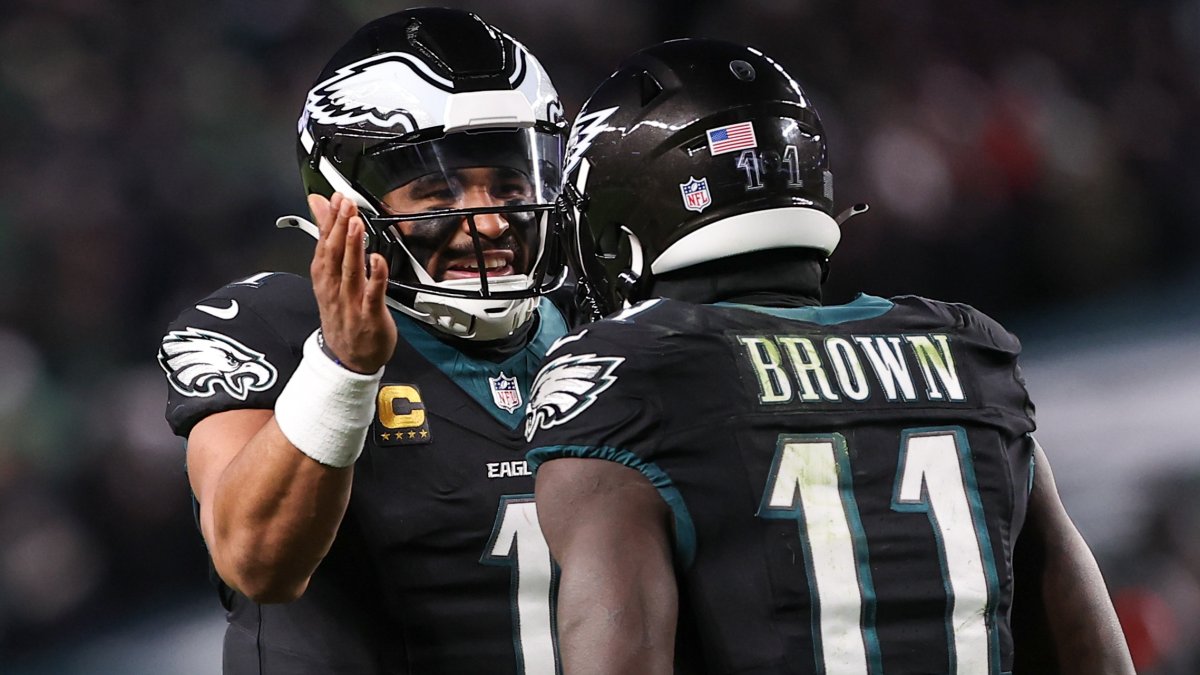
Nearby, Lane Johnson is equally focused but with a quieter demeanor. He tapes his wrists, adjusts his gloves, and spends extended time reviewing Chargers edge rusher alignments. He understands that if the Chargers cannot disrupt the Eagles’ edges, their defense becomes far more predictable and manageable. Johnson’s mentorship role continues to expand, and younger players often gravitate to him for advice on hand placement, counter moves, and the mental approach to preparing for high-level pass rushers.
Landon Dickerson brings a grounding presence, observing everything and stepping in where his leadership is most needed. Without Kelce, Dickerson has become the emotional anchor of the interior line. He is the one who communicates protections, aligns the group mentally, and keeps tension from drifting into frustration. His combination of size, intelligence, and calm makes him increasingly vital.
Rookie linemen linger nearby, absorbing not only technique but the culture of the offensive line room—a culture built on discipline, detail, and collective pride. Their presence reinforces why the line remains the soul of this team. They understand that the Chargers will test every inch of their structure with stunts, slants, and disguised blitz looks. Every rep matters. Every correction matters.
Here, in the offensive line section, the echoes of Kelce’s leadership continue. But the group is no longer trying to replace him; they are forging a new identity that blends old leadership with new responsibility. And ahead of the Chargers matchup, that identity becomes a focal point.
The Skill Positions: A Mix of Veteran Responsibility and Youthful Edge Searching for Offensive Consistency
Moving toward the offensive skill positions, the atmosphere becomes more dynamic. Receivers and running backs embody expressive energy—part confidence, part anticipation, part hunger. A.J. Brown sits at his locker in reflective thought, headphones on, nodding to a rhythm only he hears. His preparation remains intense after a stretch of mixed offensive outcomes. Brown is well aware of the defensive attention he commands, particularly from a Chargers team that can be exposed downfield but thrives when they force quarterbacks into hesitation.
DeVonta Smith moves with precise calm, engaging younger receivers in detailed conversations about route technique. Smith’s mentorship is quiet but deeply respected. He emphasizes the subtleties of spacing, leverage, and timing—elements critical to defeating the Chargers’ pattern-match coverages.
Dallas Goedert, always an energetic presence, is in mid-conversation with tight ends coach Jason Michael as he reviews blocking assignments and middle-field route leverage. Goedert understands that against the Chargers, tight ends often become hidden weapons—players who can exploit linebacker depth, manipulate safety rotations, and provide Hurts with early rhythm completions.
At the running back corner, Saquon Barkley is injecting positivity and determination into every conversation. His leadership style is uplifting rather than intense, grounded in a belief that confidence is transferable. Watching him interact with younger backs offers a glimpse into how he complements Hurts’ reserved leadership—where Hurts offers seriousness, Barkley offers inspiration.
The receivers’ section reflects a team ready to reassert its offensive explosiveness. They know the Chargers’ secondary is inconsistent, vulnerable to double moves, and sensitive to pre-snap shifts. But they also know that without precision, the defense can bait offenses into turnovers and stalled drives.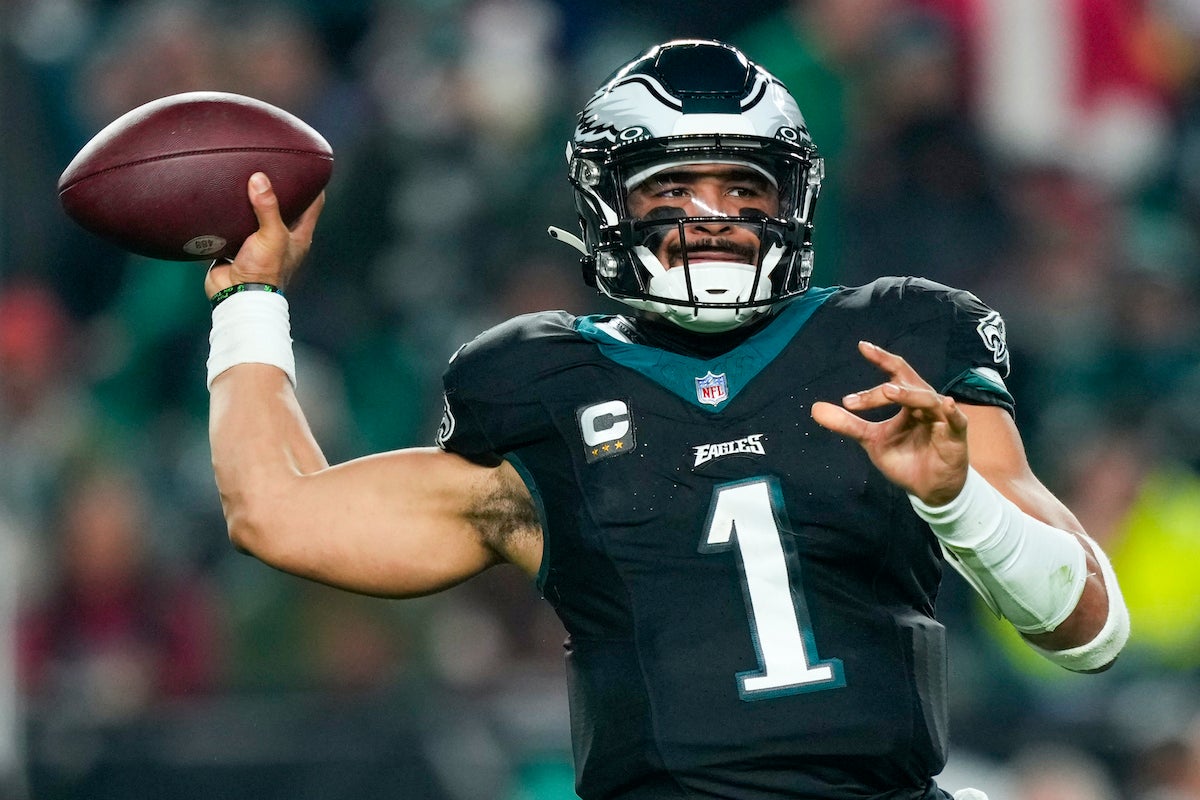
There is no panic here—just a shared understanding that the offense has not reached its ceiling. The Chargers offer an opportunity to take a step toward reclaiming it.
The Defense: A Unit Fueled by Urgency, Accountability, and Inter-Positional Collaboration
The defensive side of the locker room carries a different energy—sharper, louder, and more kinetic. This is a defense that has heard the criticism, felt the inconsistencies, and grown determined to assert itself as a tone-setter rather than a reactive unit. The emotions here are not frustration—they are focus sharpened into motivation.
Jalen Carter moves with the confidence of a young star who knows he has game-wrecking potential against a Chargers offensive line that has struggled to protect consistently. His preparation is detail-oriented, alternating between film cut-ups and in-person technique drills with positional assistants. Carter’s maturity continues to evolve, and his teammates have noted his increased vocal presence—something that wasn’t always part of his profile.
Jordan Davis serves as the defensive anchor, calm yet commanding. His leadership is rooted in physical presence and mental steadiness. Davis knows the Chargers will attempt to run away from him, but he also knows that plugging interior gaps removes Los Angeles’ ability to dictate tempo. He positions himself as the quiet fulcrum around which the rest of the front can build its pressure packages.
Haason Reddick’s absence has shifted the emotional landscape of the edge room, but Josh Sweat and Nolan Smith bring a blend of veteran expectation and youthful explosiveness. Sweat, in particular, is determined to reset his own season, treating this game as a personal starting point. His conversations with young edge defenders reveal his insistence on fundamentals—burst, hand counters, pad level—and his belief that the Eagles must regain their defensive identity through controlled violence.
In the linebacker corner, Devin White’s voice carries authority. The linebacker unit has experienced scrutiny this season, but White embraces leadership, pushing his group to tighten their communication and anticipation against a Chargers offense that thrives on horizontal misdirection and layered route concepts. His tone is decisive, energetic, and unwavering.
In the defensive backs section, Darius Slay’s presence signals the stabilizing influence the secondary needs. Slay is fully aware that the Chargers’ receiving corps can be explosive, and he moves with the confidence of someone who has faced every type of elite receiver across his career. He coaches younger corners with assertive clarity, emphasizing patience at the top of routes, hand discipline, and understanding offensive leverage.
Across the defensive room, the common theme is accountability. Not blame. Not frustration. Accountability. Each player acknowledges the unit has not played to its standard consistently enough. Each player is ready to take the Chargers matchup personally.
Coaching, Culture, and the Unseen Work: How the Eagles Prepare Beyond the Practice Field
Beyond the player sections, the corridors connecting meeting rooms, position rooms, and coaching offices reveal as much about the Eagles’ internal environment as anything on the field. Coaches move with purpose. Analysts carry tablets with breakdowns of Chargers protections and route combinations. Player-leaders walk in and out of conversations that blur the line between instruction and collaboration.
Head coach Nick Sirianni carries a demeanor that blends tough love with motivational drive. He knows the team has been uneven, but he also knows they have the talent and structure to correct themselves quickly. Sirianni’s greatest strength remains his ability to unify—not through speeches alone, but through fostering shared emotional investment. As he connects with position groups, he emphasizes not perfection, but interconnected execution.
Offensive coordinator Kellen Moore brings an intellectual intensity to the preparation week. Facing his former team in the Chargers adds a layer of complexity, but Moore is focused solely on unlocking the Eagles’ rhythm. His conversations with Hurts, the skill players, and offensive line revolve around sequencing—how to build plays that feed into each other, how to manipulate Chargers personnel rotations, and how to regain the offensive tempo that once felt effortless.
Defensive coordinator Vic Fangio, meanwhile, brings a highly analytical approach. His preparation involves deep dives into protection tendencies, quarterback tells, and split-second adjustments that disguise coverages and bait mistakes. Fangio’s influence has begun to reshape how the defense communicates. Players speak often of his clarity and expectation of discipline.
This behind-the-scenes connection between coaching strategy and player execution forms the backbone of the Eagles’ preparation. While fans see only the final product, the ecosystem inside the facility is where identity is forged.
Conclusion: A Locker Room on the Verge of Rediscovery, Ready for a Chargers Test That Will Reveal Its True Direction
A trip around the Eagles’ locker room before their showdown with the Chargers reveals far more than preparation—it reveals a team standing at a threshold. Not a crisis point, not a breaking point, but a